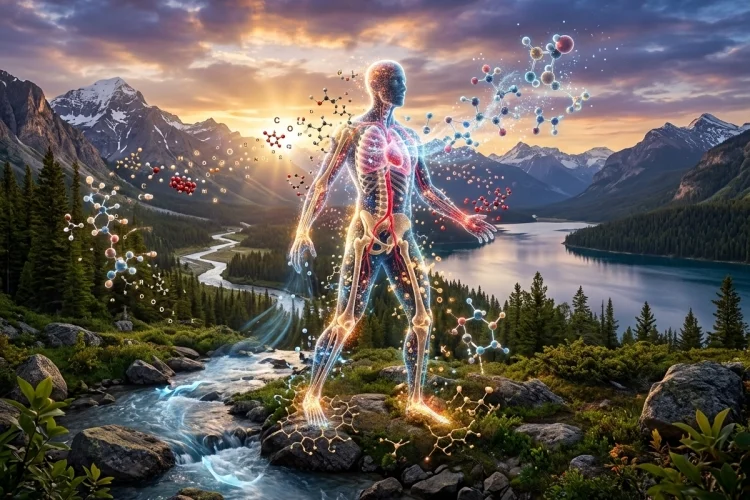
Your body may look like one complete object, but chemically, it is an incredibly complex collection of elements.
The oxygen in your body fluids, carbon in your cells, calcium in your bones, and iron in your blood all come from the same periodic table used in chemistry classrooms.
In fact, around 96% of the human body’s mass comes from only four elements: oxygen, carbon, hydrogen, and nitrogen.
The remaining percentage includes calcium, phosphorus, potassium, sulfur, sodium, chlorine, magnesium, and several trace elements required in much smaller amounts.
Understanding the chemical elements found in the human body helps explain how bones remain strong, how nerves transmit signals, how muscles contract, and how cells produce energy.
It also shows that an element does not need to be present in a large quantity to be essential. Let’s explore the major elements inside your body, what they do, and why maintaining the right balance matters.
What Are Chemical Elements?
A chemical element is a pure substance made from only one type of atom. Each element is identified by the number of protons in its atoms and is represented by a symbol, such as O for oxygen, C for carbon, and Fe for iron.
The human body cannot create chemical elements. Instead, it receives them from food, water, and the air. The body can then rearrange those elements into thousands of useful compounds, including proteins, fats, carbohydrates, hormones, and DNA.
For example, carbon, hydrogen, and oxygen can combine to form glucose. Calcium and phosphorus can form mineral structures in bones and teeth. Sodium and chlorine frequently exist as charged particles that help control fluid balance.
The amount of each element differs between individuals. Age, body composition, hydration, diet, and health can all influence the exact percentages, so the figures commonly given are useful estimates rather than fixed values for every person.
Oxygen: The Most Abundant Element by Mass
Oxygen makes up approximately 65% of human body mass. Much of it is present in water, which is a major component of blood, muscles, organs, and cells.
Oxygen is also found in proteins, carbohydrates, fats, and nucleic acids. Its ability to form strong chemical bonds makes it an important part of many biological molecules.
The oxygen you breathe has another essential role. Cells use molecular oxygen during cellular respiration, a process that helps extract usable energy from nutrients.
This does not mean the body stores all its oxygen as breathable O₂ gas. Most oxygen atoms in the body are chemically bonded to hydrogen, carbon, phosphorus, and other elements inside water and biological compounds.
Carbon: The Framework of Biological Molecules
Carbon accounts for roughly 18.5% of body mass. It forms the structural backbone of organic molecules, making it one of the most important elements in biochemistry.
A carbon atom can form four covalent bonds. It can connect to other carbon atoms to create straight chains, branches, rings, and complex three-dimensional structures.
This versatility allows carbon to form carbohydrates, proteins, lipids, vitamins, hormones, and nucleic acids. Nearly every part of a cell depends on a carbon-based framework.
Carbon also moves constantly through the body. You consume it in food, use carbon-containing molecules for energy and growth, and release some of it as carbon dioxide when you breathe out.
Hydrogen and Nitrogen: Small Atoms with Major Roles
Hydrogen makes up around 9.5% of the body by mass. Because hydrogen atoms are very light, they represent a much larger proportion when body composition is measured by the number of atoms rather than mass.
Hydrogen is present in water and almost every organic molecule. Hydrogen ions also influence acidity, commonly expressed through pH.
The body carefully controls pH because enzymes and cells usually function best within limited acidity ranges. Even modest changes in hydrogen-ion concentration can affect protein structure and biological reactions.
Nitrogen makes up approximately 3.3% of body mass. It is a central component of amino acids, which the body uses to make proteins.
Nitrogen is also found in DNA, RNA, ATP, and many important cellular molecules. Unlike carbon dioxide, which the body can remove through breathing, excess nitrogen from amino-acid metabolism is generally converted into compounds that can be removed in urine.
Calcium and Phosphorus Build More Than Bones
Calcium contributes roughly 1–2% of adult body weight, making it the most abundant mineral element in the body. More than 99% of body calcium is stored in bones and teeth.
Calcium combines with phosphorus and other components to form hydroxyapatite, the mineral material that gives bones and teeth much of their strength.
The small amount outside the skeleton is just as important. Calcium ions contribute to muscle contraction, nerve transmission, blood-vessel function, and cellular signaling.
Phosphorus is also concentrated in bones and teeth, but its role extends much further. It is part of DNA, RNA, cell membranes, and ATP, the molecule cells use to transfer energy.
Phosphate groups can also be attached to proteins and other molecules to change their activity. Cells use this process to control numerous biochemical pathways.
Sodium, Potassium, and Chlorine Act as Electrolytes
Sodium, potassium, and chlorine are commonly found in the body as electrically charged ions. Substances that form mobile ions in body fluids are called electrolytes.
Sodium is the major positive ion in fluid outside cells, while potassium is the major positive ion inside cells. This uneven distribution is essential for nerve signals, muscle function, and the movement of materials across cell membranes.
Chlorine is usually present as the negatively charged chloride ion. It helps maintain electrical neutrality, fluid distribution, and acid–base balance. Chloride also contributes to hydrochloric acid in the stomach.
The body regulates electrolyte concentrations closely. Too much or too little water can change their concentration, which is why fluid and electrolyte balance are linked.
Calcium and magnesium can also function as electrolytes. Magnesium contributes to energy transfer, enzyme activity, muscle function, and the structure of bones.
Sulfur Supports Proteins and Cellular Chemistry
Sulfur is present in smaller amounts than the major four elements, but it has several important functions.
It is found in the amino acids cysteine and methionine. When proteins contain cysteine, sulfur atoms can form links known as disulfide bonds, helping stabilize the protein’s three-dimensional shape.
These bonds contribute to the structure of proteins in hair, skin, and connective tissues. Sulfur is also present in certain vitamins and coenzymes involved in metabolism.
The element is usually obtained through protein-containing foods rather than consumed as isolated sulfur. The body then incorporates it into amino acids and other biological compounds.
Why Trace Elements Still Matter
Trace elements occur in extremely small amounts, but small does not mean unimportant. Iron, zinc, copper, iodine, selenium, manganese, cobalt, and molybdenum all support specialized biological functions.
1. Iron
Iron is best known for its role in hemoglobin, the protein in red blood cells that transports oxygen. It is also present in myoglobin and enzymes involved in energy metabolism.
2. Zinc and Copper
Zinc helps support hundreds of enzymes and contributes to protein structure, gene regulation, immune function, and tissue repair. Copper is also part of many enzymes and assists with processes involving energy production and iron metabolism.
3. Iodine and Selenium
Iodine is required to make thyroid hormones, which influence metabolism, growth, and development. Selenium is incorporated into proteins involved in antioxidant protection and thyroid-hormone metabolism.
4. Cobalt and Molybdenum
Cobalt is found inside vitamin B12, a nutrient needed for normal blood-cell formation and neurological function. Molybdenum is part of several enzymes that process sulfur-containing compounds and other substances.
These elements must remain within suitable ranges. A deficiency may interrupt essential processes, but excessive exposure can also be harmful. More is not automatically better.
Where Do the Body’s Elements Come From?
The body receives oxygen mainly through breathing, while most other essential elements arrive through food and drinks.
Protein-rich foods supply carbon, hydrogen, oxygen, nitrogen, and sulfur. Dairy products, leafy vegetables, legumes, fish, and fortified foods can provide calcium, although the exact sources vary by diet.
Fruits and vegetables can supply potassium and magnesium, while table salt and processed foods commonly provide sodium and chloride. Iron, zinc, copper, iodine, and selenium occur in different animal and plant foods, with their amounts and absorption varying considerably.
The body does not simply absorb everything consumed. Digestion, chemical form, interactions with other nutrients, and individual physiology all affect how much of an element becomes available.
Once absorbed, elements may circulate in blood, become stored in tissues, join biological molecules, or eventually leave through urine, feces, sweat, and exhaled air.
The Body Is About Balance, Not Just Amount
An element can be essential and still become harmful at excessive levels. The body therefore uses organs, hormones, transport proteins, and cellular systems to control elemental balance.
Calcium levels, for example, are carefully regulated because calcium is needed for nerve and muscle activity. Bones can serve as a reservoir, releasing or storing calcium as part of that regulation.
Iron is carried and stored by specialized proteins because free iron can participate in damaging chemical reactions. Sodium and potassium concentrations are regulated partly through the kidneys and hormones.
This process of maintaining stable internal conditions is called homeostasis. Health depends not only on having the right elements but also on keeping them in the correct locations, chemical forms, and concentrations.
The human body is built mainly from oxygen, carbon, hydrogen, and nitrogen, which together account for about 96% of its mass.
Calcium and phosphorus strengthen bones and support cellular functions, while sodium, potassium, chlorine, magnesium, and sulfur contribute to signaling, metabolism, and fluid balance.
Trace elements such as iron, zinc, iodine, copper, and selenium are present in much smaller quantities but still perform essential jobs. Every element has a specific role, and the body must carefully control its concentration.
Next time you look at the periodic table, remember that it is not only a classroom chart. Many of its elements are working inside your cells right now. Continue exploring minerals, biomolecules, and metabolism to discover how these simple atoms create a functioning human body.