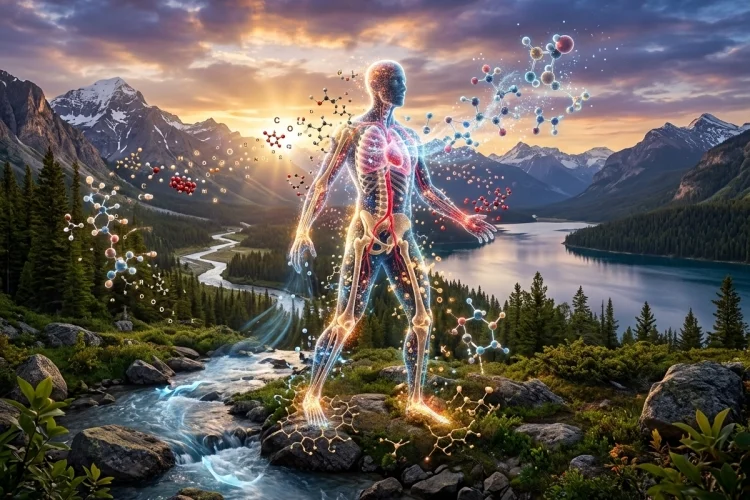
Water looks simple. Each molecule contains only two hydrogen atoms and one oxygen atom, yet this small molecule makes nearly every biological process possible.
Inside living cells, chemical reactions do not happen in a dry, empty space. They take place in an aqueous environment where molecules can dissolve, move, collide, interact, and react with one another.
Water accounts for roughly 70% or more of the mass of many cells, which immediately shows how deeply biology depends on it. Understanding why water is essential for biological reactions requires looking beyond hydration.
Water acts as a solvent, participates directly in chemical reactions, helps stabilize temperature, influences protein structure, and allows substances to move throughout cells and organisms.
Most of these abilities come from one important feature: water is a polar molecule capable of forming hydrogen bonds. Those seemingly simple properties create the chemical enviroment in which life can function.
Let’s look at exactly how it works.
1. Water Is an Excellent Solvent for Biological Molecules
One of water’s most important biological roles is acting as a solvent.
A water molecule is polar because oxygen attracts shared electrons more strongly than hydrogen. This creates a slightly negative region near the oxygen atom and slightly positive regions around the hydrogen atoms.
Because of these partial charges, water interacts easily with ions and other polar molecules. Sodium ions, chloride ions, sugars, amino acids, and many other biologically important substances can become surrounded by water molecules and dispersed throughout a solution.
This matters because dissolved molecules can move around and interact.
Imagine glucose entering a cell. Before enzymes can process that glucose during metabolism, it needs to exist within the watery cytoplasm where it can encounter the appropriate proteins and other reactants.
Water essentially provides the molecular meeting place where much of cellular chemistry occurs.
Nonpolar substances behave differently. Oils and many lipids do not dissolve easily in water, creating what scientists call the hydrophobic effect. Surprisingly, this limitation is also biologically useful because it helps organize important cellular structures.
2. Water Provides the Medium for Cellular Reactions
Cells contain thousands of chemical reactions happening in coordinated networks.
These reactions involve molecules constantly moving through the cytoplasm, encountering enzymes, transferring atoms, exchanging electrons, and changing into new products. Since the cytoplasm is largely water, cellular metabolism takes place mainly within an aqueous environment.
Water allows many reactants to remain dissolved rather than locked inside solid structures. Their movement increases opportunities for molecules to encounter one another and participate in chemical reactions.
Consider cellular respiration. Cells gradually break down fuel molecules and transfer energy through a complex sequence of reactions. Many of the enzymes, ions, substrates, and intermediate molecules involved operate in water-based cellular compartments.
The same basic principle applies to digestion, photosynthesis, DNA replication, and numerous other biological processes.
Water is therefore not simply something surrounding these reactions. It helps create the physical and chemical conditions needed for their occurence.
3. Water Can Participate Directly in Chemical Reactions
Water does more than provide a place for reactions to happen. Sometimes it becomes one of the reactants.
A classic example is hydrolysis.
During hydrolysis, a water molecule helps break a chemical bond. The water contributes components that become attached to the resulting molecules. Biological systems frequently use hydrolysis when breaking larger molecules into smaller units.
For example, large food molecules must often be broken down before cells can use their components. Proteins can ultimately be separated into amino acids, while complex carbohydrates can be broken into simpler sugars through sequences that involve hydrolytic reactions.
The opposite type of process is often described as dehydration synthesis or a condensation reaction. In simplified biological examples, smaller units combine to form larger molecules while water is produced as part of the reaction.
This makes water part of the actual chemistry of building and breaking biological molecules, rather than just a passive background liquid.
4. Water Helps Proteins and Enzymes Work Properly
Enzymes are proteins that speed up biological reactions. For an enzyme to work correctly, its three-dimensional structure must place specific amino acids in the right positions.
Water helps influence that structure.
Proteins contain regions that interact differently with an aqueous environment. Some groups interact readily with water, while hydrophobic groups generally tend to avoid contact with it. These interactions contribute to how proteins fold into functional shapes.
Water also forms hydrogen bonds with many polar groups on biological molecules. Although individual hydrogen bonds are relatively weak, large numbers of them can significantly influence moleculer structure and stability.
This is especially important for enzymes because shape affects function.
If conditions such as temperature, pH, or solvent composition disrupt a protein’s structure too severely, an enzyme may lose its ability to bind its substrate effectively.
Water therefore contributes indirectly to countless reactions simply by helping maintain the molecular environment in which enzymes operate.
5. Water Helps Keep Reaction Temperatures Stable
Biochemical reactions are sensitive to temperature.
Too little thermal energy can slow many reactions, while excessive heat can alter proteins and damage cellular structures. Living organisms therefore benefit from conditions that do not change temperature too dramatically.
Water is particularly useful because it has a relatively high heat capacity.
Hydrogen bonding allows water to absorb substantial amounts of thermal energy while experiencing comparatively moderate temperature changes. This helps buffer cells, tissues, aquatic environments, and entire organisms against sudden thermal fluctuations.
Water also has a high heat of vaporization.
When sweat evaporates from human skin, for example, energy is required to move water molecules into the gas phase. That energy is taken from the surrounding surface, producing a cooling effect.
Maintaining a stable temperatue matters because biological reactions work best within particular ranges.
In that sense, water acts as a thermal buffer that helps chemistry remain predictable enough for life to continue.
6. Water Helps Create Cell Membranes and Biomolecular Structures
One of biology’s most important structures-the cell membrane-also depends heavily on water.
Cell membranes contain phospholipids with water-friendly, or hydrophilic, regions and water-avoiding, or hydrophobic, regions.
When these molecules are placed in water, their different interactions with the surrounding liquid encourage them to organize into membrane-like structures.
This behavior is not accidental. It comes from the way polar and nonpolar molecules interact in an aqueous environment. NCBI notes that these interactions play crucial roles in forming biological structures such as cell membranes.
The same general principle influences proteins and other macromolecular assemblies.
Water can affect folding, molecular recognition, binding, and interactions between charged or polar groups. A biomolecule’s behavior therefore depends not only on its own atoms but also on how those atoms interact with surrounding water.
This is one reason biochemistry cannot be fully understood by looking at biological molecules in isolation.
7. Water Supports Transport and Chemical Homeostasis
Biological reactions also depend on getting the right substances to the right places.
Water makes that transportation possible.
Blood plasma, cellular fluid, and other biological solutions carry dissolved ions, nutrients, signaling molecules, and metabolic products. Inside cells, substances can diffuse through aqueous compartments and reach locations where they are needed.
Water also contributes to acid-base chemistry.
A small fraction of water molecules can dissociate into hydrogen-related and hydroxide-related species, connecting water chemistry with pH. Biological systems carefully regulate pH because many enzymes function properly only within certain ranges.
In other words, water helps maintain chemical homeostasis-the stable internal conditions required for cellular processes.
Without sufficient water, concentrations of dissolved substances can change, transport becomes disrupted, temperature regulation becomes more difficult, and normal biochemical processes can be affected.
That is why water is not simply another nutrient. It is part of the operating system of life.
Water is essential for biological reactions because it performs several jobs at once.
It dissolves ions and polar molecules, provides an aqueous medium for metabolism, participates directly in hydrolysis and related reactions, supports protein structure, stabilizes temperature, and helps organize cell membranes.
Its polarity and ability to form hydrogen bonds explain much of this remarkable chemistry. A molecule that looks incredibly simple on paper creates the conditions that allow enormously complex living systems to function.
The next time you think about water, look beyond its role in preventing thirst. Think of it as the chemical environment where much of life’s molecular activity happens.
If you want to understand biology more deeply, studying water’s properties is one of the best places to start.