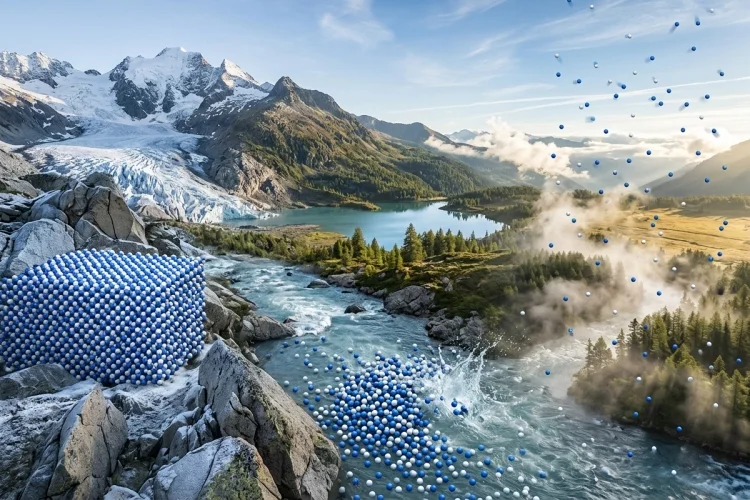
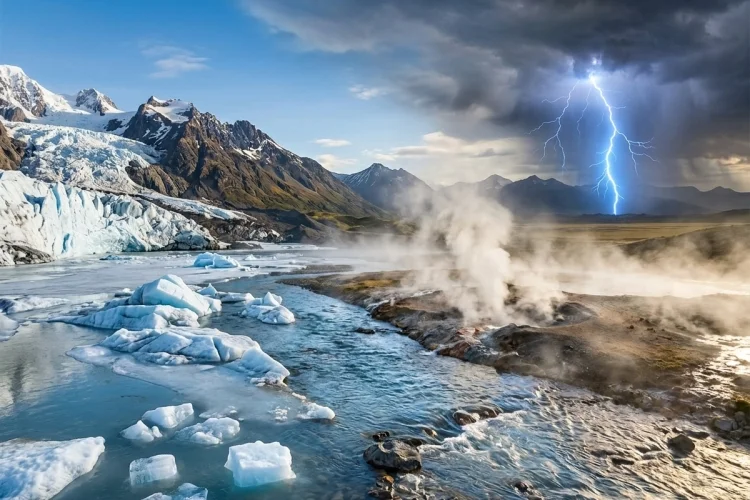
Ice cubes, drinking water, and steam may look completely different, but they are all made from the same substance: H₂O. What changes is not the chemical identity of the water but the way its particles move, interact, and arrange themselves.
This is the basic idea behind the states of matter. A state of matter is a physical form that a substance can take under particular conditions.
Solid, liquid, and gas are the three states we experience most often on Earth, while plasma is common in lightning, stars, and other high-energy environments. Scientists also study more unusual forms, including Bose-Einstein condensates.
Understanding the states of matter explained at the particle level helps make sense of melting ice, boiling water, foggy windows, dry ice, and even glowing neon signs. It also reveals why temperature and pressure can dramatically change how a material behaves.
Let’s explore what makes each state different and how matter moves from one form to another.
What Is Matter?
Matter is anything that has mass and occupies space. Rocks, water, air, plants, animals, buildings, and electronic devices are all made of matter.
Matter consists of particles such as atoms, molecules, or ions. The way these particles are arranged and how freely they can move help determine whether a material behaves as a solid, liquid, gas, or another physical state.
A change of state usually does not create a new chemical substance. When ice melts, its H₂O molecules remain H₂O. Only their movement and arrangement change, so melting is classified as a physical change rather than a chemical reaction.
Solids: Particles Held in Place
A solid has a definite shape and a definite volume. A book stays book-shaped when you place it on a table, and an ice cube does not spread out to fill the bottom of a glass.
The particles in a solid are packed closely together and held in relatively fixed positions by attractive forces. They are not completely motionless; they vibrate around their positions, with the amount of motion increasing as the temperature rises.
Some solids have highly ordered structures. Salt, many metals, and numerous minerals form crystals in which particles follow repeating patterns.
Other solids are amorphous, meaning they lack the same long-range repeating arrangement. Glass and many plastics are common examples. Although both crystalline and amorphous materials are solids, their internal structures and responses to heating can differ.
Liquids: Close Together but Free to Flow
A liquid has a definite volume but not a fixed shape. Pour juice into a tall glass and it becomes tall and narrow; pour it into a bowl and it becomes wide and shallow.
Liquid particles remain close together, but they are not locked into fixed positions. They can move past one another, allowing the liquid to flow and take the shape of its container.
Attractive forces between liquid particles also create surface tension. This is why small water droplets tend to form rounded shapes and why certain lightweight objects can rest on water when placed carefully.
Liquids also have viscosity, which describes their resistance to flowing. Water has a relatively low viscosity, while honey moves more slowly because it has a much higher viscosity.
Gases: Particles Moving Freely
A gas has neither a fixed shape nor a fixed volume. It spreads out to fill the container in which it is placed.
Gas particles are generally much farther apart than those in liquids and solids. They move rapidly in different directions and collide with one another and with the walls of their container. These collisions help produce gas pressure.
Because there is plenty of space between the particles, gases can be compressed more easily than liquids or solids. Pumping air into a bicycle tire pushes more gas particles into a limited volume, increasing the pressure.
Temperature strongly influences gas behavior. Heating a gas generally increases the average kinetic energy of its particles, making them move faster. If the container can expand, the gas may occupy more space; if it cannot, the pressure may rise.
Plasma: The Electrically Charged State
Plasma is sometimes called the fourth state of matter. It forms when enough energy is supplied to a gas for electrons to separate from atoms, producing a mixture of positively charged ions and free electrons.
Because plasma contains moving charged particles, it behaves differently from an ordinary gas. It can conduct electricity and respond strongly to electric and magnetic fields.
Plasma appears in lightning, fluorescent lamps, neon signs, and the Sun. Although it is less familiar in everyday life than solids, liquids, and gases, the U.S. Department of Energy states that plasma makes up most of the visible matter in the universe.
Not every hot gas automatically becomes plasma. Sufficient energy must be present to ionize at least some of its atoms or molecules.
Bose-Einstein Condensates and Other Unusual States
Solid, liquid, gas, and plasma are not the only possible forms of matter. Under extreme conditions, particles can display unusual collective behavior that does not fit neatly into the four familiar categories.
A Bose-Einstein condensate, or BEC, forms when certain particles are cooled to extremely low temperatures near absolute zero. Their quantum wave properties begin to overlap, causing many particles to behave like one collective quantum object.
The first gaseous Bose-Einstein condensates were produced in laboratories in 1995. NASA later created BECs aboard the International Space Station, where microgravity allows scientists to observe them for longer periods.
BECs are often called the fifth state of matter, although scientists study several other specialized phases. The familiar list of four or five states is therefore an introduction, not a complete catalogue of everything matter can become.
How Matter Changes from One State to Another
Matter changes state when conditions such as temperature or pressure alter the balance between particle motion and attractive forces.
When a solid absorbs enough energy, its particles can move more freely and it melts into a liquid. When a liquid loses energy, it may freeze and become solid.
Vaporization changes a liquid into a gas, while condensation turns a gas into a liquid. Boiling is one form of vaporization that occurs throughout a liquid at its boiling point, while evaporation happens at the surface and can occur below that temperature.
Some substances move directly between solid and gas. Sublimation changes a solid into a gas without passing through the liquid state. Dry ice, which is solid carbon dioxide, is a familiar example under normal atmospheric conditions.
The reverse process is deposition, in which a gas becomes a solid. Frost can form through deposition when water vapor changes directly into ice on a sufficiently cold surface.
Melting, vaporization, and sublimation absorb energy, while freezing, condensation, and deposition release energy.
Why Temperature Is Not the Only Factor
It is tempting to think that heating always moves matter from solid to liquid to gas. In reality, pressure also plays a major role.
Water normally boils at about 100°C at standard atmospheric pressure, but its boiling point changes when the surrounding pressure changes. At high altitudes, lower atmospheric pressure allows water to boil at a lower temperature.
A pressure cooker does the opposite. It raises the pressure inside the pot, increasing water’s boiling point and allowing food to cook at a higher temperature.
Scientists use phase diagrams to show which state of a substance is stable at different combinations of temperature and pressure. These diagrams include boundaries where two states coexist, along with a triple point where solid, liquid, and gas can exist in equilibrium.
A phase diagram may also show a critical point. Beyond this condition, the distinction between liquid and gas disappears, creating a supercritical fluid with a combination of liquid-like and gas-like properties.
States of Matter in Everyday Life
State changes are happening throughout your daily routine. Ice melts in a drink, wet clothes dry through evaporation, and water vapor condenses on a cold bathroom mirror.
Refrigerators use cycles of evaporation and condensation to transfer heat. Air conditioners rely on related phase-change processes to cool indoor spaces.
Cloud formation also involves changes of state. Water evaporates from oceans, lakes, soil, and plants, then later condenses into tiny droplets or freezes into ice crystals in the atmosphere.
Cooking depends heavily on these ideas. Boiling, steaming, freezing, and pressure cooking all use temperature and phase behavior to change food texture and control heat transfer.
Industries apply the same principles to separate chemicals, preserve food, produce liquid gases, create advanced materials, and manage energy. Understanding physical states is therefore useful far beyond the science classroom.
The main states of matter are solid, liquid, gas, and plasma, with unusual states such as Bose-Einstein condensates appearing under extreme conditions. Their differences come from particle arrangement, movement, energy, and the forces acting between particles.
Solids keep their shape, liquids flow while maintaining volume, gases expand to fill containers, and plasmas contain electrically charged particles. Matter can move between these forms through melting, freezing, vaporization, condensation, sublimation, and deposition.
Start observing these changes in your surroundings. Watch ice melt, steam condense, or water evaporate, then imagine what the particles are doing. That simple habit can turn ordinary experiences into practical lessons about how matter behaves.