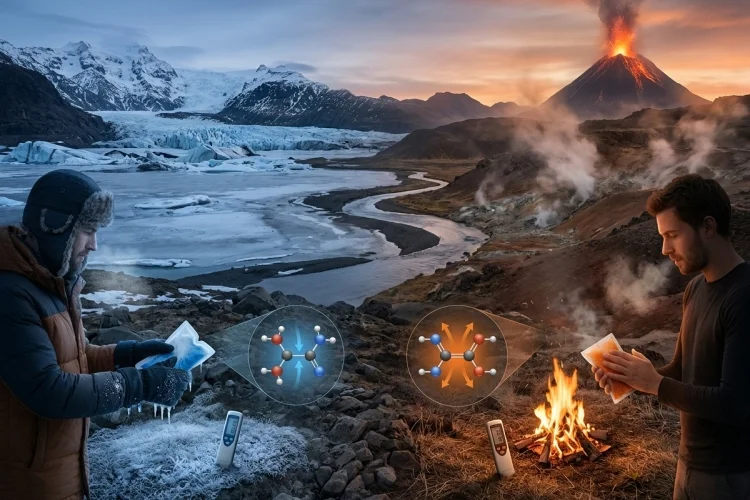
Why does a hand warmer become hot while an instant cold pack becomes chilly? Both products involve changes at the molecular level, but heat moves in opposite directions.
This is the central difference between endothermic and exothermic reactions. An endothermic reaction absorbs heat from its surroundings, while an exothermic reaction releases heat into them.
As a result, the surroundings often feel colder during an endothermic process and warmer during an exothermic one. However, the topic involves more than simply checking whether something feels hot or cold.
Chemical bonds must be broken and formed, reactions may need activation energy, and temperature changes can sometimes happen without a chemical reaction.
Understanding endothermic vs. exothermic reactions helps explain combustion, instant cold packs, hand warmers, batteries, cooking, and many industrial processes. It also introduces important chemistry concepts such as enthalpy, bond energy, reaction profiles, and catalysts.
What Are Endothermic and Exothermic Reactions?
An endothermic reaction is a chemical process that absorbs heat from its surroundings. Energy moves from the surrounding environment into the reacting system.
An exothermic reaction does the opposite. It transfers heat from the chemical system into the surroundings.
The word parts can help you remember the distinction. Endo means “inside,” suggesting heat moves into the system. Exo means “outside,” indicating that heat moves out of the reaction and into its environment.
At constant pressure, chemists describe this heat transfer using enthalpy change, written as ΔH. Exothermic reactions have a negative ΔH, while endothermic reactions have a positive ΔH.
The Main Difference Is the Direction of Heat Flow
The clearest way to compare these reactions is to identify the system and the surroundings.
The system is the chemical reaction being studied. The surroundings include everything outside that system, such as the container, thermometer, air, or your hand.
| Feature | Endothermic Reaction | Exothermic Reaction |
|---|---|---|
| Direction of heat | Into the system | Out of the system |
| Effect on surroundings | Often becomes cooler | Often becomes warmer |
| Sign of ΔH | Positive | Negative |
| Product enthalpy | Higher than reactants | Lower than reactants |
| Common example | Some instant cold packs | Combustion |
Suppose a reaction mixture absorbs heat from the water around it. The water loses thermal energy and its temperature falls. This indicates an endothermic process.
If the reaction transfers heat into the water, the temperature rises. The process is exothermic.
The terms describe heat flow from the perspective of the chemical system, not simply whether the system itself feels hot or cold.
How Chemical Bonds Affect Reaction Energy
Chemical reactions rearrange atoms. Bonds in the reactants may be broken, and new bonds are formed as products appear.
Breaking a chemical bond always requires energy. The bonded atoms must be pulled apart against the attractive forces holding them together.
Forming a new bond releases energy because the atoms enter a more stable arrangement. Whether the overall reaction is endothermic or exothermic depends on the balance between these two energy changes.
1. Why Some Reactions Are Exothermic
A reaction is exothermic when forming the new bonds releases more energy than is needed to break the original bonds.
The extra energy leaves the system, usually as heat. Light, sound, or electrical energy may also be produced, depending on the reaction.
2. Why Some Reactions Are Endothermic
A reaction is endothermic when breaking the reactant bonds requires more energy than is released during the formation of product bonds.
The additional energy must come from the surroundings. This heat transfer can cause the temperature outside the reacting system to decrease.
This corrects a common misunderstanding: breaking bonds does not release energy. Bond breaking requires energy, while bond formation releases it.
Understanding Enthalpy and Energy Diagrams
Enthalpy is a useful measurement for describing energy changes in reactions carried out at constant pressure. Chemists calculate the enthalpy change using:
ΔH = H(products) − H(reactants)
For an exothermic reaction, the products have lower enthalpy than the reactants. The value of ΔH is therefore negative.
For an endothermic reaction, the products have higher enthalpy. This produces a positive ΔH.
A reaction-energy diagram displays these differences visually. The vertical axis represents energy, while the horizontal axis represents the reaction’s progress.
In an exothermic diagram, the products finish below the reactants. In an endothermic diagram, the products finish above them.
Both diagrams also normally contain a peak. This peak represents the energy barrier that must be crossed before the reaction can proceed.
Both Types May Need Activation Energy
It is easy to assume that an exothermic reaction should begin automatically because it releases energy. In reality, many exothermic reactions need an initial energy input.
This starting barrier is called activation energy. Reacting particles need enough energy-and usually a suitable orientation-to reach the transition state and begin forming products.
A match is a familiar example. Burning the match is exothermic, but it does not ignite while sitting inside its box. Striking it supplies frictional heat that helps the chemicals overcome the activation-energy barrier.
Endothermic reactions also have activation energy. The difference between endothermic and exothermic processes describes the net heat transfer, not whether an initial barrier exists.
What Does a Catalyst Do?
A catalyst increases the rate of a reaction by providing an alternative pathway with lower activation energy. This allows more reacting particles to overcome the energy barrier under the same conditions.
However, a catalyst does not change whether a reaction is endothermic or exothermic. The reactants and products retain the same energy difference, so the overall ΔH remains unchanged.
On an energy diagram, the catalyzed pathway has a lower peak, but it begins and ends at the same levels as the uncatalyzed pathway.
Catalysts are important in biological and industrial chemistry. Enzymes catalyze reactions in living organisms, while manufactured catalysts help produce fuels, fertilizers, plastics, and medicines more efficiently.
Common Examples of Exothermic Reactions
Combustion is one of the best-known exothermic processes. When fuels react with oxygen, energy is released into the surroundings as heat and often light.
Burning wood, natural gas, candle wax, and gasoline all involve exothermic reactions. The exact products depend on the fuel and the amount of oxygen available.
Disposable hand warmers provide another everyday example. Many contain iron powder that reacts gradually with oxygen. This oxidation process releases heat, warming the material around it.
Acid–base neutralization can also be exothermic. When certain acids and bases react, the temperature of the solution increases because heat is transferred to the surroundings.
Some reactions release heat so rapidly that they produce intense flames, sparks, or explosions. Others release it slowly enough to provide controlled warmth for several hours.
Common Examples of Endothermic Reactions
Some instant cold packs use an endothermic dissolving process. When the internal compartments are mixed, a salt dissolves in water and absorbs heat from the surroundings, making the pack colder.
Not every endothermic process is a chemical reaction. Melting ice and boiling water absorb heat, but they are physical changes because the substance remains H₂O.
Thermal decomposition reactions are chemical examples. Calcium carbonate must continuously absorb energy when it breaks down into calcium oxide and carbon dioxide:
CaCO₃ → CaO + CO₂
This process is important in cement and lime production, where high temperatures are required to drive the transformation.
Photosynthesis also requires an energy input from sunlight to help convert carbon dioxide and water into energy-rich substances. It is frequently used as a broad example of an energy-absorbing chemical process, although its biological mechanism involves many linked reactions.
How to Identify the Reaction Type Experimentally
The simplest classroom method is to measure the temperature of the surroundings before and after a reaction.
First, record the initial temperature of the solution or reaction container. Allow the reaction to begin, then measure the highest or lowest temperature reached.
A temperature increase in the surroundings suggests an exothermic reaction. A decrease suggests an endothermic one. ACS classroom investigations use these temperature changes to compare the two reaction types.
For more accurate measurements, chemists use a calorimeter. This device measures heat transfer by monitoring temperature changes in a controlled environment.
The energy transferred can often be estimated using:
q = mcΔT
In this equation, q is heat energy, m is mass, c is specific heat capacity, and ΔT is the temperature change.
Careful experiments must also account for heat lost to the container and surrounding air. A poorly insulated cup may produce a smaller measured temperature change than the reaction actually caused.
Temperature Change Does Not Always Mean Chemical Reaction
A warmer or colder mixture does not automatically prove that new substances have formed.
Physical changes can also absorb or release heat. Melting and evaporation are endothermic physical processes, while freezing and condensation release heat.
Dissolving can be either endothermic or exothermic depending on the balance of particle interactions. It may involve the formation of a solution without creating a chemically new solute. ACS notes that dissolving processes can raise or lower temperature.
To confirm a chemical reaction, look for additional evidence. Possible signs include gas production, a lasting color change, formation of a precipitate, light, or new chemical properties.
Common Misconceptions
One common mistake is assuming that all exothermic reactions happen quickly. Reaction rate and reaction enthalpy are different concepts.
Rusting is exothermic overall, but it usually occurs slowly. Other reactions may absorb heat yet proceed quickly once their activation barrier has been overcome.
Another misconception is that endothermic reactions are always naturally cold. They only cool their surroundings when the heat they absorb is not quickly replaced by another source.
Exothermic also does not mean “requires no energy.” Combustion can release a large amount of heat while still needing a spark or flame to begin.
Finally, endothermic and exothermic do not directly tell us whether a reaction is spontaneous. Spontaneity also depends on entropy and temperature, concepts described more fully through Gibbs free energy.
Why These Reactions Matter in Everyday Life
Exothermic and endothermic processes are used to control energy in homes, transportation, medicine, manufacturing, and biological systems.
Combustion releases energy for heating and engines. Batteries use chemical reactions to generate electrical energy, while rechargeable systems use an external energy supply to reverse certain chemical changes.
Cold packs absorb heat to provide temporary cooling, while hand warmers release it. Cooking uses heat to drive chemical transformations that would happen too slowly at room temperature.
Industrial chemists also manage these energy changes carefully. Strongly exothermic reactions may require cooling systems to prevent overheating, while endothermic processes may need continuous heating to maintain production.
Understanding heat transfer helps scientists make reactions safer, more efficient, and easier to control.
The main difference between endothermic and exothermic reactions is the direction in which heat moves. Endothermic reactions absorb heat from their surroundings and have a positive ΔH, while exothermic reactions release heat and have a negative ΔH.
These energy changes result from the balance between energy absorbed when bonds break and energy released when new bonds form. Both reaction types may require activation energy, and catalysts can lower this barrier without changing the overall enthalpy.
Start noticing energy changes in daily life, from cold packs and hand warmers to cooking and burning fuel. Ask where the heat is moving, identify the system and surroundings, and use that evidence to classify the process.