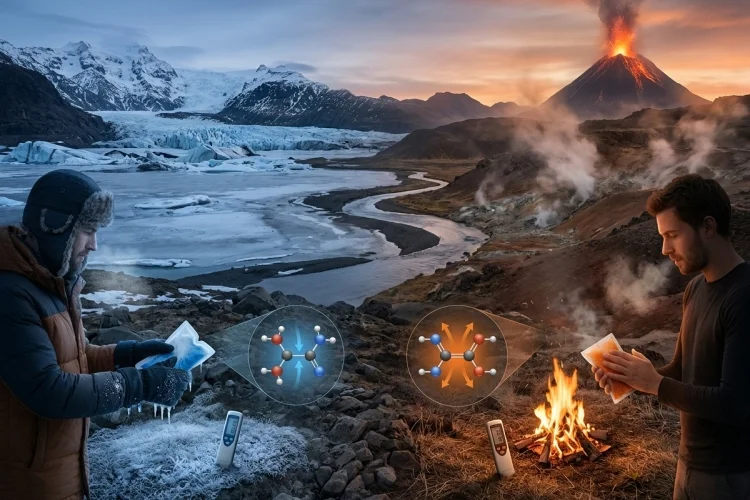

Strike a match, and a tiny flame suddenly releases heat and light. Place an instant cold pack on an injury, and it becomes noticeably colder. Both examples involve chemical reactions, but energy moves differently in each one.
So, what is energy in a chemical reaction? Energy is the capacity of a system to produce change or transfer heat and work.
During a reaction, atoms are rearranged, chemical bonds are broken or formed, and energy is exchanged between the reacting system and its surroundings. Some reactions release more energy than they absorb, making the surroundings warmer.
Others require a net input of energy and may cool the nearby environment. Even reactions that eventually release energy often need an initial push before they can begin.
Understanding reaction energy helps explain combustion, batteries, digestion, photosynthesis, cooking, and industrial manufacturing.
It also introduces essential ideas such as chemical potential energy, activation energy, enthalpy, exothermic reactions, endothermic reactions, and catalysts.
What Does Energy Mean in Chemistry?
In chemistry, energy can appear in several forms, including thermal, electrical, radiant, kinetic, and chemical potential energy. A reaction may convert energy from one form into another.
A battery, for example, converts chemical energy into electrical energy. Combustion transforms part of a fuel’s chemical potential energy into heat and light, while photosynthesis uses light energy to support the production of energy-rich chemical substances.
The total amount of energy is conserved. It does not appear from nowhere or vanish completely. Instead, it is transferred between the chemical system and its surroundings or converted into another form.
Thermochemistry is the area of chemistry that examines the relationships between chemical processes, heat, work, and other forms of energy.
How Chemical Bonds Are Connected to Energy
A chemical reaction rearranges atoms by changing their bonds. Some bonds in the reactants may break, while new bonds form in the products.
Breaking a chemical bond requires energy. This is because energy must be supplied to pull bonded atoms apart against the attractive interactions holding them together.
Forming a bond has the opposite effect. When atoms move into a more stable bonded arrangement, energy is released to the surroundings.
The overall energy change depends on the balance between these two processes.
If forming the product bonds releases more energy than is required to break the reactant bonds, the reaction releases energy overall. If bond breaking requires more than bond formation releases, the reaction absorbs energy.
It is therefore misleading to say that breaking bonds releases energy. Energy may be released during the complete reaction, but breaking the original bonds always requires an input.
Exothermic vs. Endothermic Reactions
Chemical reactions are often classified as exothermic or endothermic according to the direction of net energy transfer.
1. Exothermic Reactions
An exothermic reaction transfers energy from the reacting system to its surroundings. The surroundings may become warmer, and energy may also appear as light, sound, or electrical energy.
Burning wood, natural gas, or candle wax involves exothermic chemistry. Disposable hand warmers also use reactions that release heat gradually.
In an exothermic reaction, the products have lower enthalpy than the reactants, so the enthalpy change, written as ΔH, is negative. More energy is released during bond formation than is consumed while breaking the original bonds.
2. Endothermic Reactions
An endothermic reaction absorbs energy from its surroundings. As heat flows into the system, the surroundings may become colder.
Some instant cold packs rely on an endothermic dissolving process. Photosynthesis also requires a continuing input of light energy, although it is a complex biological process rather than one simple reaction.
For an endothermic process, the products have higher enthalpy than the reactants, and ΔH is positive. The system absorbs more energy than it releases.
What Is Activation Energy?
A reaction can release energy overall and still need energy to get started. The minimum energy barrier associated with initiating a reaction is called activation energy.
A match illustrates this idea well. The chemicals in the match head do not normally ignite while sitting in the box. Striking the match creates friction and heat, helping the reacting particles overcome the initial energy barrier.
Once combustion begins, it releases enough heat to support further reactions in the nearby material. The reaction can then continue until the fuel or another necessary reactant is no longer available.
According to collision theory, reacting particles need to collide with sufficient energy and a suitable orientation. Collisions that fail to meet these conditions do not necessarily produce products.
Activation energy affects reaction rate rather than simply determining whether products have more or less energy than reactants. A reaction with a large energy barrier may happen extremely slowly, even if it is energetically favorable overall.
How Catalysts Change Reaction Energy
A catalyst is a substance that increases the rate of a chemical reaction by providing an alternative pathway with a lower activation-energy barrier.
Imagine trying to cross a mountain. A catalyst does not lower your starting point or final destination; it provides an easier route between them.
Importantly, a catalyst does not change the overall enthalpy difference between reactants and products. It changes the pathway and rate, not the net energy released or absorbed by the reaction.
Catalysts are also regenerated during the process rather than being permanently consumed as a reactant. They may still lose effectiveness over time because of contamination, damage, or unwanted changes.
Enzymes are biological catalysts that allow reactions inside living organisms to happen fast enough under relatively mild conditions. Industrial catalysts are used to produce fuels, fertilizers, plastics, medicines, and many other materials more efficiently.
Understanding Enthalpy and Energy Diagrams
Chemists often use enthalpy, represented by the symbol H, to describe energy changes in processes carried out at constant pressure. The enthalpy change of a reaction is written as ΔH.
It can be expressed simply as:
ΔH = H(products) − H(reactants)
When ΔH is negative, the reaction is exothermic. When it is positive, the process is endothermic.
An energy diagram shows the relative energy of the reactants, the products, and the high-energy region that must be crossed during the reaction. The peak represents the transition-state region, while the height from the reactants to that peak corresponds to an activation barrier.
A catalyst creates a pathway with a lower peak. However, the starting and finishing energy levels remain unchanged, so ΔH stays the same.
Energy is commonly reported in joules or kilojoules. Reaction enthalpies are often written in kilojoules per mole, or kJ/mol, so chemists can compare energy changes for specific quantities of substances.
Does a Temperature Change Always Prove a Reaction?
A temperature change can be useful evidence that energy is being transferred, but it does not automatically prove that a chemical reaction has occurred.
Ice absorbs heat while melting, yet melting is a physical change because solid and liquid water are both made of H₂O. Water also absorbs energy while boiling without becoming a chemically different substance.
Dissolving can produce temperature changes as well. Depending on the substances involved, the overall dissolving process may release or absorb heat as particle attractions are broken and replaced.
To decide whether a reaction occurred, look for evidence that new substances formed. A temperature change becomes more convincing when it appears alongside other clues, such as gas production, a lasting color change, light, or the formation of a new solid.
Energy in Everyday Chemical Reactions
Energy changes are involved in many ordinary activities. Your body releases usable energy through a network of reactions that process nutrients, while muscles convert some of that energy into movement and heat.
Cooking also depends on energy. Heat helps molecules overcome activation barriers, allowing browning, protein changes, and other transformations to occur at useful rates.
Batteries use oxidation-reduction reactions to generate an electrical current. Charging a rechargeable battery supplies electrical energy that supports chemical changes in the reverse direction.
Cars, power stations, and gas stoves use combustion to release energy from fuels. Cleaner technologies, including fuel cells and improved batteries, also depend on carefully controlled chemical transformations.
Industry uses catalysts to make many of these reactions faster and more energy efficient. Lowering the required operating temperature or pressure can reduce energy use, costs, and unwanted by-products.
Common Misunderstandings About Reaction Energy
One common misunderstanding is that exothermic always means fast. In reality, energy change and reaction speed are different ideas. A reaction can release substantial energy but proceed slowly because it has a high activation barrier.
Another misconception is that catalysts add energy to reactions. Catalysts provide a different pathway; they do not supply the net energy released by an exothermic process.
It is also incorrect to assume that an endothermic reaction cannot happen naturally. Whether a process can occur depends on more than heat flow alone, including changes in entropy and Gibbs energy.
For beginner chemistry, the most useful distinction is this: enthalpy change describes the energy difference between reactants and products, while activation energy describes the barrier between them.
Energy in a chemical reaction is transferred as atoms rearrange and chemical bonds change. Breaking bonds requires energy, while forming bonds releases it. The balance determines whether a process is exothermic or endothermic.
Activation energy is the initial barrier that reacting particles must overcome. Catalysts speed reactions by lowering that barrier without changing the overall enthalpy difference between the starting materials and products.
These concepts explain why a match needs friction, why a cold pack cools down, and how batteries, cooking, digestion, and industrial production work.
Start observing energy changes around you and ask whether heat is entering or leaving the system. Then explore reaction-energy diagrams to see how chemists visualize those changes.