
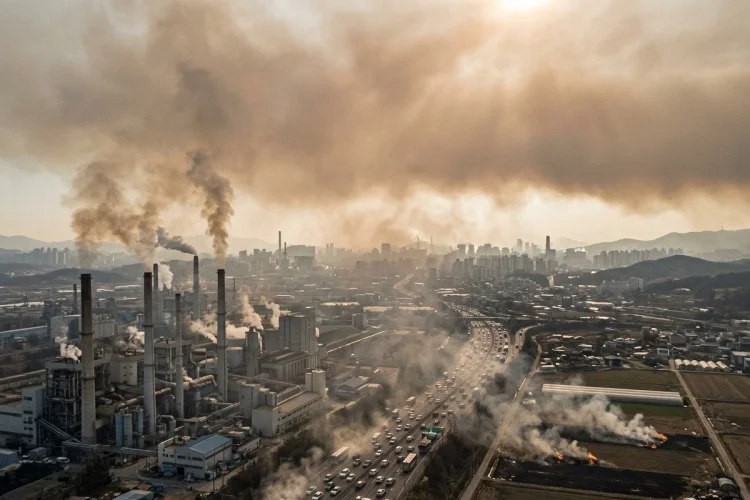
Air pollution is not always as obvious as a cloud of dark smoke rising from a factory. Some pollutants are invisible gases, while others are particles so small that they can only be detected with specialized equipment.
So, how is air pollution created? It begins when gases, particles, or biological materials enter the atmosphere at concentrations that can harm people, ecosystems, buildings, or the climate.
Some pollutants are released directly from sources such as vehicles, power plants, fires, and household stoves. Others form later when emitted chemicals react with sunlight, oxygen, water vapor, or other compounds in the air.
This means pollution can be both a physical emissions problem and an atmospheric chemistry problem. Exhaust released in one location may travel, react, and contribute to smog or fine-particle pollution somewhere else.
Understanding how air pollution forms helps explain why clear-looking air is not always clean, why sunny days can produce more ozone, and why certain weather conditions trap pollutants near the ground.
What Is Air Pollution?
Air pollution is a mixture of unwanted gases, particles, and other substances in indoor or outdoor air. Major pollutants of concern include particulate matter, carbon monoxide, ground-level ozone, nitrogen dioxide, sulfur dioxide, and certain toxic chemicals.
These pollutants do not all come from the same source or behave in the same way. Carbon monoxide is a gas, particulate matter includes solid particles and liquid droplets, and ground-level ozone forms through chemical reactions rather than being emitted directly.
Pollution levels also vary by place and time. A busy urban road may have high vehicle-related emissions, while a rural area may experience smoke from agricultural burning, wildfires, or household fuel use.
Air quality is therefore shaped by three main factors: how much pollution is released, how the chemicals react, and how weather transports or traps them.
Primary and Secondary Air Pollutants
One of the easiest ways to understand air pollution is to divide pollutants into primary and secondary categories.
A primary pollutant is released directly into the atmosphere. Examples include soot from a diesel engine, dust from a construction site, sulfur dioxide from fuel combustion, and carbon monoxide from incomplete burning.
A secondary pollutant forms in the atmosphere after other chemicals react. Ground-level ozone is a major example. Much of the fine particulate matter found in outdoor air also develops through reactions involving gaseous emissions.
The difference matters because reducing visible smoke alone may not solve the entire problem. Invisible gases can continue reacting after their release and create new pollutants many kilometers away.
Fuel Combustion Creates Many Pollutants
Combustion is one of the largest human-related sources of air pollution. It occurs whenever fuels such as coal, oil, gasoline, diesel, natural gas, wood, or waste are burned.
Ideally, complete combustion of a hydrocarbon fuel mainly produces carbon dioxide and water. Real combustion is rarely perfect, especially when there is insufficient oxygen, poor mixing, or unsuitable temperature.
Incomplete combustion can produce carbon monoxide, soot, and unburned organic compounds. Carbon monoxide forms when carbon-containing fuel is not fully oxidized.
High-temperature combustion can also produce nitrogen oxides, commonly called NOx. Sulfur-containing fuels may release sulfur dioxide, while tiny pieces of ash and soot become particulate pollution.
These emissions can come from engines, power stations, industrial boilers, fireplaces, generators, cooking stoves, and open fires.
Vehicles, Factories, and Power Plants
Cars, trucks, buses, ships, airplanes, and construction equipment are known as mobile emission sources. Their engines can release nitrogen oxides, carbon monoxide, volatile organic compounds, and particles.
Vehicles may also create pollution without burning fuel. Brake wear, tire wear, and road dust contribute particles to the air. Fuel can evaporate during storage and refueling, releasing volatile chemicals.
Factories, refineries, steel mills, chemical plants, and power stations are stationary sources. The exact emissions depend on the fuel used, the manufacturing process, and the pollution-control equipment installed.
Smaller businesses and facilities can also contribute. Gas stations, dry cleaners, workshops, printing operations, and paint shops may individually emit less than a major industrial complex, but their combined impact can become important in populated areas.
Pollution from these sources is often concentrated near cities and industrial zones, but wind can carry it far beyond the original location.
How Ground-Level Ozone and Smog Form
The ozone layer high in the atmosphere helps protect Earth from harmful ultraviolet radiation. Ground-level ozone, however, is a pollutant and a major component of photochemical smog.
It is not pumped directly from a vehicle exhaust pipe or factory chimney. Instead, it forms when nitrogen oxides react with volatile organic compounds in the presence of sunlight.
Nitrogen oxides can come from engines, power plants, and industrial combustion. Volatile organic compounds, or VOCs, are released by fuels, paints, solvents, chemical products, industrial operations, and natural vegetation.
Sunny, warm, and relatively stagnant conditions can encourage ozone formation. This is why ozone pollution often becomes worse on hot summer afternoons, even when emissions began earlier in the day.
The chemistry is complicated because lowering one pollutant does not always produce an equal reduction in ozone everywhere. Local amounts of NOx, VOCs, sunlight, and background pollution all affect the result.
How Particulate Matter Is Created
Particulate matter, or PM, is a mixture of solid particles and liquid droplets suspended in the air. It includes dust, smoke, soot, metals, salts, acids, and organic material.
Some particles are released directly. Fires produce smoke and soot, construction activities create dust, and engines can emit tiny carbon-rich particles.
Other particles form through atmospheric reactions. Sulfur dioxide, nitrogen oxides, ammonia, and organic gases can react and produce sulfates, nitrates, and other secondary particles.
In the United States, secondary formation accounts for much of the fine-particle pollution.
Particle size is important. PM10 refers to particles with diameters of 10 micrometers or smaller, while PM2.5 includes particles no larger than 2.5 micrometers.
Fine particles can remain airborne for long periods and travel over large distances. They are also more difficult to see, so serious particle pollution can exist even when the sky does not look smoky.
Air Pollution Can Be Created Indoors
Air pollution is not only an outdoor problem. Indoor air can contain pollutants from cooking, heating, smoking, cleaning, building materials, furniture, hobbies, and consumer products.
Fuel-burning stoves, fireplaces, heaters, and generators may release particles, nitrogen dioxide, and carbon monoxide, especially when they are poorly maintained or inadequately ventilated.
Paints, varnishes, air fresheners, cleaning agents, adhesives, cosmetics, and solvents can release VOCs. Concentrations may rise during use and remain elevated afterward if air circulation is limited.
The World Health Organization identifies inefficient and polluting household fuels and technologies as major sources of household air pollution. In poorly ventilated homes, smoke and fine-particle levels can become extremely high.
Outdoor pollution can also enter through windows, doors, ventilation systems, and small openings in buildings.
Natural Sources Also Pollute the Air
Not all air pollution is caused by human activity. Wildfires release smoke, carbon monoxide, nitrogen oxides, and VOCs. Volcanoes can emit sulfur dioxide, ash, and other gases.
Wind can lift soil and desert dust into the atmosphere, while oceans produce salt particles. Trees and other plants naturally release organic compounds that can participate in atmospheric chemistry.
Pollen, mold spores, and microorganisms also enter the air. These materials may be natural, but high concentrations can still reduce air quality or cause health problems.
Human activities can intensify natural pollution. Climate and land-use changes may affect wildfire conditions, while construction and agriculture can disturb soil and increase dust emissions.
Natural and human-made pollutants can also mix. Smoke from a wildfire may combine with urban emissions and sunlight, creating a more complicated air-pollution episode.
Weather Can Spread or Trap Pollution
Creating emissions is only the first part of the story. Weather determines whether pollution disperses, travels, reacts, or accumulates near the surface.
Wind can dilute local pollutants but carry them into another region. Rain can remove some particles and soluble gases from the atmosphere, although those substances may then enter soil and water.
A temperature inversion can trap pollution near the ground. Under normal conditions, warmer surface air rises and helps mix the lower atmosphere. During an inversion, a warmer layer sits above cooler surface air and limits vertical movement.
Pollutants then build up beneath the warmer layer, especially in valleys and cities with weak winds. Persistent cold-air inversions have been associated with severe winter pollution episodes.
Sunlight, humidity, cloud cover, and temperature also affect chemical reaction rates. Air pollution is therefore the result of both emissions and changing atmospheric conditions.
How Air Pollution Can Be Reduced
Reducing air pollution begins with controlling emissions at their sources. Cleaner energy, efficient public transport, lower-emission vehicles, industrial filters, and better fuel standards can reduce the chemicals released into the atmosphere.
Preventing incomplete combustion also matters. Engines and household appliances should be maintained properly, while fuel-burning equipment needs safe ventilation.
Indoors, source control is often more effective than trying to filter every pollutant afterward. Using lower-emission products, avoiding indoor smoking, ventilating while cooking, and following product instructions can help.
Individuals cannot solve regional air pollution alone, but daily choices still contribute. Using less fuel, avoiding unnecessary burning, conserving energy, and checking local air-quality information can support wider policies and reduce personal exposure.
Air pollution is created when gases, particles, and toxic substances are released from vehicles, factories, power plants, fires, household appliances, and consumer products.
Some pollutants enter the air directly, while others form later through reactions involving sunlight, oxygen, water, nitrogen oxides, sulfur dioxide, and VOCs.
Ground-level ozone and much of fine-particle pollution are secondary pollutants, making atmospheric chemistry a major part of the problem. Weather can then disperse pollution or trap it close to the ground.
Pay attention to pollution sources in your home and community, follow local air-quality reports, and reduce avoidable fuel use or burning where practical. Understanding how polluted air is created is the first step toward supporting cleaner, healthier environments.