
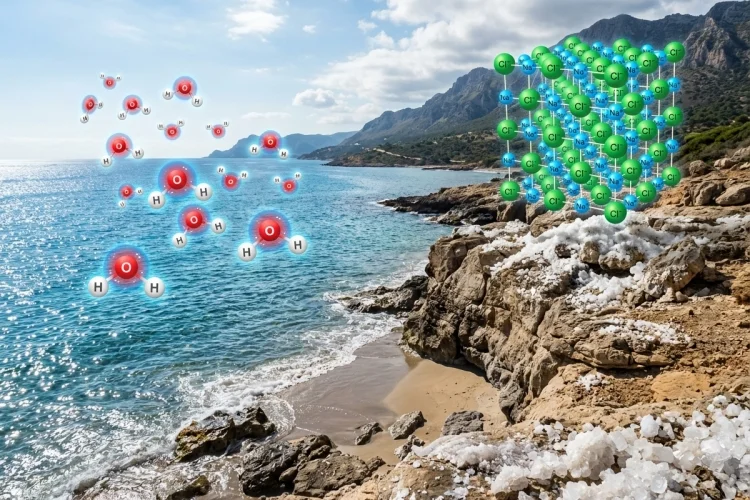
Salt dissolves in water, sugar melts when heated, and copper carries electricity through a wire. These materials behave differently partly because their atoms are connected in different ways.
Two of the most important types of chemical bonding are ionic and covalent bonding. Both involve valence electrons, but they handle those electrons differently.
Ionic bonds are usually explained through electron transfer and attraction between charged ions, while covalent bonds form when atoms share electron density.
Understanding ionic bonds vs. covalent bonds makes it easier to predict how a substance might behave. Bonding can influence whether a material forms crystals or molecules, whether it dissolves in water, and whether it conducts electricity.
However, the difference is not always as simple as “transfer versus sharing.” Real chemical bonds exist along a spectrum, and some compounds contain both ionic and covalent interactions.
This guide breaks down the main differences without making the chemistry unnecessarily complicated.
What Is an Ionic Bond?
An ionic bond is the electrostatic attraction between oppositely charged ions. These ions form when atoms or groups of atoms gain or lose electrons.
An atom that loses electrons becomes a positively charged ion called a cation. An atom that gains electrons becomes a negatively charged ion called an anion. Because opposite electrical charges attract, the cations and anions are held together.
Sodium chloride is the classic example. Sodium can lose one electron to form Na⁺, while chlorine can gain one electron to form Cl⁻. The attraction between these ions contributes to the structure of table salt.
Ionic compounds do not normally exist as separate two-particle “molecules.” In solid sodium chloride, huge numbers of sodium and chloride ions form a repeating three-dimensional crystal lattice.
What Is a Covalent Bond?
A covalent bond forms when atoms share electron density. The shared electrons are attracted to the nuclei of both atoms, helping hold the atoms together.
Covalent bonding commonly occurs between nonmetal atoms. For example, two hydrogen atoms share electrons to form H₂, while hydrogen and oxygen share electrons in a water molecule.
Atoms may share one, two, or three pairs of electrons. These arrangements are called single, double, and triple bonds. Nitrogen gas, for instance, contains a strong triple bond between two nitrogen atoms.
Not all sharing is equal. When one atom attracts the shared electrons more strongly, the result is a polar covalent bond. If the attraction is approximately equal, the bond is considered nonpolar covalent.
The Main Difference: Electron Transfer vs. Sharing
The easiest way to compare ionic and covalent bonds is to focus on what happens to the valence electrons.
In the basic ionic model, electrons are transferred from one atom to another. This creates charged particles whose attraction produces an ionic structure.
In a covalent bond, the electron density is shared between atoms. The atoms remain connected because the shared electrons interact with both nuclei.
Ionic bonding is especially common between metals and nonmetals. Metals tend to lose valence electrons more easily, while nonmetals tend to attract additional electrons.
Covalent bonding is more typical between two nonmetals whose attraction for electrons is not different enough to produce complete transfer.
This distinction is useful for beginners, but it is a model rather than a perfect division. Many bonds have a mixture of ionic and covalent character.
How Electronegativity Helps Predict Bond Type
Electronegativity describes an atom’s ability to attract electrons within a chemical bond. Differences in electronegativity help chemists estimate whether a bond will be nonpolar covalent, polar covalent, or strongly ionic.
When two identical atoms bond, their electronegativity difference is zero. They attract the electrons equally, producing a nonpolar covalent bond.
When the difference is moderate, the electrons are shared unequally. One end of the bond develops a partial negative charge, while the other develops a partial positive charge. This is a polar covalent bond.
A very large electronegativity difference usually indicates substantial ionic character. OpenStax, for example, compares H-H, H-Cl, and Na-Cl to show how increasing electronegativity differences move bonding from nonpolar covalent toward ionic.
There is no single universal numerical boundary that perfectly classifies every bond. Electronegativity guidelines are helpful predictions, not absolute laws.
How Their Structures Differ
Ionic compounds typically form extended crystal lattices. Each ion is surrounded by several oppositely charged ions rather than being paired with only one partner.
This organized structure helps explain why common ionic solids are hard but brittle. If layers of ions shift, particles with the same charge may be pushed beside one another. Their repulsion can cause the crystal to crack.
Many covalent substances, by contrast, exist as separate molecules. Water, carbon dioxide, methane, and sugar are familiar molecular substances held together internally by covalent bonds.
However, not every covalent substance consists of small molecules. Diamond and quartz are network covalent solids in which atoms are connected throughout a large structure. These materials can be extremely hard and have very high melting points.
The structure of a substance is therefore just as important as the label “ionic” or “covalent.” Two compounds containing covalent bonds may have completely different properties if one forms small molecules and the other forms a continuous network.
Melting and Boiling Points
Ionic compounds often have relatively high melting and boiling points. A large amount of energy may be needed to overcome the strong electrostatic attractions throughout their crystal lattices.
Sodium chloride, for example, remains solid at ordinary room temperature. Heating it enough to melt requires disrupting attractions among many ions, not simply separating individual pairs.
Molecular covalent substances frequently have lower melting and boiling points. When they melt or boil, the covalent bonds inside the molecules usually remain intact. The process mainly overcomes the weaker attractions between separate molecules.
This is why gases such as oxygen and carbon dioxide can exist at room temperature, while many ionic salts remain solid. However, network covalent materials are major exceptions because their extended covalent structures can require enormous amounts of energy to break apart.
Electrical Conductivity
Electrical conductivity depends on whether charged particles can move through a material.
A solid ionic compound generally does not conduct electricity well because its ions are locked into fixed positions within the crystal lattice. The charges exist, but they cannot travel freely.
When the compound melts or dissolves in water, its ions can move. Molten sodium chloride and saltwater can therefore conduct electrical current.
Most molecular covalent substances are poor electrical conductors because they do not contain freely moving ions or electrons. Sugar dissolved in water, for example, forms neutral molecules rather than mobile charged particles.
There are exceptions. Graphite is a covalent material that can conduct electricity because parts of its electron system are delocalized and able to move through its layered structure. This shows why chemical structure matters more than memorizing a simple rule.
Solubility in Water and Other Liquids
Many ionic compounds dissolve in water because water is a polar molecule. Its partially charged regions can attract ions, pull them away from a crystal, and surround them in solution.
Still, not every ionic substance is highly soluble. Solubility depends on the balance between attractions inside the ionic lattice and attractions between the ions and water molecules.
Covalent substances vary even more widely. Polar molecules such as sugar can interact with water and often dissolve well. Nonpolar substances such as oil do not interact strongly with water and tend to remain separate.
This pattern is sometimes summarized as “like dissolves like.” Polar solvents usually dissolve polar or ionic substances more effectively, while nonpolar solvents are often better at dissolving nonpolar compounds.
The rule is useful, but molecular size, temperature, intermolecular forces, and structural details can also influence solubility.
Can a Compound Contain Both Bond Types?
Ionic and covalent bonding can occur within the same compound. Ammonium nitrate is one example.
Inside the ammonium ion, nitrogen and hydrogen atoms are connected through covalent bonds. The positively charged ammonium ion is then attracted ionically to the negatively charged nitrate ion, which also contains internal covalent bonds.
Similar combinations occur in compounds containing polyatomic ions such as carbonate, sulfate, hydroxide, and phosphate. The atoms inside each ion share electrons, while oppositely charged ions attract one another.
It is also important to remember that purely ionic and purely covalent bonds are idealized extremes. IUPAC recommends thinking in terms of the degree of ionic character rather than treating every bond as completely ionic or completely covalent.
Why the Difference Matters in Everyday Life
Bond type helps explain why salt forms brittle crystals while water remains liquid at room temperature. It also helps us understand why saltwater conducts electricity but a sugar solution conducts very poorly.
Ionic compounds are important in electrolytes, batteries, ceramics, minerals, and biological processes. Sodium, potassium, calcium, and chloride ions all perform essential roles in the human body.
Covalent compounds include water, fuels, plastics, medicines, proteins, fats, carbohydrates, and DNA. The variety of covalent structures is one reason carbon can form millions of different compounds.
Scientists use bonding knowledge to design medicines, electronic materials, coatings, fertilizers, batteries, and industrial chemicals. Understanding the difference allows them to predict properties before a material is manufactured or tested.
The main difference between ionic and covalent bonds involves how valence electrons are handled. Ionic bonding is associated with electron transfer and attraction between positively and negatively charged ions.
Covalent bonding involves atoms sharing electron density. These bonding patterns influence crystal structure, melting point, solubility, conductivity, and other physical properties.
However, the categories are not completely separate. Polar covalent bonds sit between the two extremes, and many compounds contain both ionic and covalent interactions. Try comparing familiar substances such as salt, sugar, water, and cooking oil.
Consider their structures, solubility, and conductivity, then connect those observations to their chemical bonds. From there, explore electronegativity, Lewis structures, and molecular polarity to deepen your understanding.