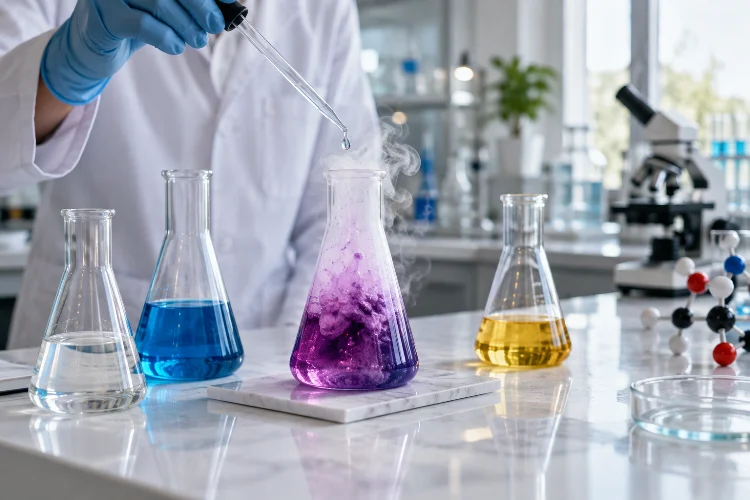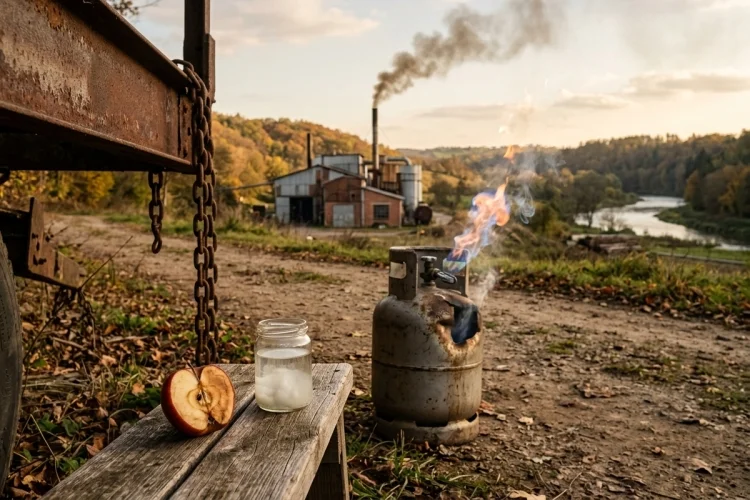
Chemical reactions are happening around you all the time. They occur when bread browns in a toaster, iron develops rust, fuel burns inside an engine, and your body digests its latest meal.
But what is a chemical reaction? In simple terms, it is a process that transforms one or more chemical substances into different substances.
The starting materials are called reactants, while the newly formed substances are known as products. IUPAC describes a chemical reaction as a process that results in the interconversion of chemical species.
During this transformation, atoms are rearranged rather than simply disappearing. Existing chemical bonds may break, new bonds may form, and the resulting products can have properties that are very different from those of the reactants.
You do not need an advanced chemistry degree to understand the basic idea. Once you know how atoms rearrange, how equations represent reactions, and how energy affects the process, chemical changes become much easier to recognize.
What Happens During a Chemical Reaction?
A chemical reaction changes the way atoms are connected. The atoms present before the reaction remain present afterward, but they are arranged into new molecules, ions, or structures.
Consider the formation of water. Hydrogen and oxygen can react to produce water molecules. The hydrogen and oxygen atoms are not destroyed; they become connected in a new arrangement.
This rearrangement matters because a substance’s properties depend on its composition and structure. Hydrogen is a flammable gas, oxygen supports combustion, yet water is a liquid commonly used to control fires.
At the molecular level, reactions may involve breaking existing chemical bonds and forming new ones. The overall transformation can happen in a single step or through a more complicated sequence called a reaction mechanism.
Reactants, Products, and Chemical Equations
Chemists use chemical equations as compact descriptions of reactions. Reactants are written on the left side, products appear on the right, and an arrow shows the direction of the transformation.
A simple example is the reaction between hydrogen and oxygen:
2H₂ + O₂ → 2H₂O
In this equation, hydrogen and oxygen are the reactants, while water is the product. The numbers placed before the formulas are called coefficients.
These coefficients ensure that the equation is balanced. There are four hydrogen atoms and two oxygen atoms on both sides, so the equation accounts for every atom involved.
Balancing equations reflects the law of conservation of matter. In an ordinary chemical reaction, atoms are rearranged but are not created or destroyed. A correct equation must therefore contain the same number of each type of atom on both sides.
How Can You Recognize a Chemical Reaction?
Chemical reactions are sometimes easy to notice. A dramatic flame, an explosion, or a sudden color change clearly suggests that something is happening.
Many reactions are much less obvious. Some occur slowly, such as rust forming on iron or fruit turning brown after it has been cut.
Common clues include a lasting color change, gas production, a new odor, light emission, a temperature change, or the formation of a solid called a precipitate. A reaction may display one or several of these signs.
However, these observations are clues rather than perfect proof. Bubbles can appear when water boils, but boiling is a physical change rather than a chemical reaction. The bubbles are water vapor, not a newly formed substance.
The most reliable evidence is the formation of substances with new chemical identities and properties. Chemists may confirm this through measurements, chemical tests, or instruments that analyze molecular composition.
Chemical Reactions vs. Physical Changes
A chemical reaction produces new substances. A physical change alters a material’s form, size, or state without changing its fundamental chemical identity.
Melting ice is a physical change. Solid H₂O becomes liquid H₂O, but the molecules remain water. Freezing, boiling, cutting, crushing, and dissolving can also be physical processes, depending on the substances involved.
Burning wood is different. Combustion produces substances such as carbon dioxide, water vapor, ash, and various gases. Because the original material is converted into chemically different products, burning is a chemical change.
Cooking an egg is another chemical example. Heat changes the structures of proteins, causing them to unfold and form new connections. The cooked egg cannot easily be returned to its original raw state.
Reversibility can be a useful clue, but it is not a strict rule. Some physical changes are difficult to reverse, while certain chemical reactions can proceed in both directions.
Common Types of Chemical Reactions
Chemists classify reactions to make their patterns easier to understand. The categories can overlap, but they provide a useful starting point for beginners.
1. Synthesis and Decomposition
In a synthesis reaction, simpler substances combine to create a more complex product. A general pattern is:
A + B → AB
A decomposition reaction follows the opposite pattern. One compound breaks into two or more simpler products:
AB → A + B
2. Combustion Reactions
Combustion usually involves a substance reacting rapidly with oxygen and releasing energy. Burning natural gas, petrol, wood, or a candle involves combustion chemistry.
Complete combustion of a hydrocarbon mainly produces carbon dioxide and water. Limited oxygen can lead to incomplete combustion and the formation of carbon monoxide or soot.
3. Acid-Base Reactions
An acid-base reaction commonly involves the transfer of a proton or the interaction of hydrogen and hydroxide ions. When an acid and a base neutralize each other, salt and water may form.
Antacid tablets provide an everyday example. Their active ingredients react with some of the acid in the stomach, helping reduce excessive acidity.
4. Oxidation-Reduction Reactions
Oxidation-reduction, or redox, reactions involve the transfer or redistribution of electrons. Corrosion, combustion, photosynthesis, cellular respiration, and battery operation all involve redox chemistry.
These reaction types are among the common frameworks used to classify chemical transformations, including precipitation, acid–base, and redox processes.
Why Energy Is Important in Chemical Reactions
Chemical reactions involve energy because chemical bonds are associated with potential energy. Breaking bonds requires an energy input, while forming new bonds releases energy.
An exothermic reaction transfers energy to its surroundings, often as heat or light. Combustion is a familiar example, although not every exothermic process produces a visible flame.
An endothermic reaction absorbs energy from its surroundings. Some instant cold packs use an endothermic process that draws in heat, causing the pack to feel cold.
A reaction may be energetically favorable yet still require an initial push. This minimum energy barrier is known as activation energy.
A match does not ignite simply because oxygen is present. Friction supplies enough initial energy to begin the reaction, after which combustion releases additional heat.
The overall energy change depends on the balance between the energy needed to break bonds and the energy released as new ones form.
What Controls the Speed of a Reaction?
Chemical reactions can happen in tiny fractions of a second or take many years. Their speed is known as the reaction rate.
Temperature often increases reaction speed because particles move faster and collide more frequently and energetically. This is one reason food spoils more slowly in a refrigerator.
Concentration can also matter. When more reactant particles occupy the same space, successful collisions may happen more often.
Increasing surface area can speed up reactions involving solids. Powdered material usually reacts faster than one large piece because more particles are exposed.
A catalyst increases reaction rate by providing a more efficient pathway with a lower activation-energy barrier. It participates in the process but is not consumed as part of the final products.
Enzymes are biological catalysts. They help digestion, energy production, DNA-related processes, and many other reactions occur quickly enough to support life.
Chemical Reactions in Everyday Life
Your body depends on a vast network of chemical reactions. Digestion breaks large food molecules into smaller units, while cellular respiration helps release usable energy from nutrients.
Cooking also involves multiple transformations. Browning bread, caramelizing sugar, fermenting dough, and cooking meat all depend on changes in molecular structure.
Household batteries use redox reactions to convert stored chemical energy into electrical energy. Cleaning products rely on reactions and molecular interactions to remove stains, neutralize acids, or deactivate microorganisms.
Plants use photosynthesis to convert carbon dioxide and water into energy-rich compounds with the help of light. Vehicles, factories, medicines, agriculture, and water-treatment systems also rely heavily on controlled reactions.
Chemical reactions are therefore not limited to laboratory experiments. They explain how materials change, how living organisms function, and how much of modern technology works.
A chemical reaction is a process in which reactants are transformed into new products through the rearrangement of atoms and chemical bonds. The atoms remain accounted for, which is why chemical equations must follow the law of conservation of matter.
Reactions may release or absorb energy, happen quickly or slowly, and follow patterns such as synthesis, decomposition, combustion, acid-base, or redox chemistry. Temperature, concentration, surface area, and catalysts can all influence their speed.
Start observing the reactions happening in your own routine. Look at bread browning, metal rusting, food digesting, or a battery powering a device. Then explore balanced equations and reaction types to understand how chemists describe these everyday transformations.