
Have you ever wondered why bread turns brown in the oven, why iron develops rust, or how a small battery can power your phone? These events may seem unrelated, but they can all be explained through chemistry.
So, what is chemistry? In simple terms, chemistry is the science of matter-what it is made of, how it behaves, and how it changes. It helps us understand everything from the air we breathe and the food we eat to medicines, fuels, plastics, and living cells.
The American Chemical Society describes chemistry as the study of matter and the changes it can undergo. Chemistry can look intimidating because it uses formulas, symbols, calculations, and unfamiliar vocabulary.
However, its central ideas are surprisingly logical. Once you understand atoms, elements, compounds, chemical reactions, and energy, the physical world starts to make much more sense.
This beginner’s guide explains the foundations of chemistry in plain English, using practical examples you can recognize in everyday life.
What Does Chemistry Study?
Chemistry examines the composition, structure, properties, and transformations of matter. Matter is anything that has mass and occupies space, including the chair beneath you, the water in a glass, and the invisible air around you.
Chemists ask questions such as: What is a material made of? Why does it have certain properties? What happens when it is heated, cooled, mixed, or exposed to another substance?
The subject connects three different perspectives. We observe changes in the visible world, explain them through the behavior of atoms and molecules, and represent them using chemical formulas or equations.
Because chemistry connects closely with physics, biology, medicine, engineering, agriculture, and environmental science, it is often described as a central science.
Understanding Matter and Its Different States
Matter usually appears as a solid, liquid, or gas. The state of a material depends largely on how its particles are arranged, how freely they can move, and how much energy they possess.
In a solid, particles remain close together and mainly vibrate in fixed positions. This gives the material a definite shape and volume. Ice, metal, wood, and glass are familiar examples.
In a liquid, particles are still close together, but they can move past one another. A liquid therefore keeps its volume while taking the shape of its container.
Gas particles are much farther apart and move freely. This allows gases to expand and fill the available space.
Plasma is another important state of matter. It is made of charged particles and can be found in lightning, neon signs, and stars. The U.S. Department of Energy explains that plasma makes up most of the visible matter in the universe.
Changes between states are usually physical changes. When ice melts, for example, solid water becomes liquid water, but its chemical identity remains H₂O.
Atoms, Elements, Molecules, and Compounds
Atoms are the tiny building blocks of ordinary matter. Each atom contains a central nucleus made of protons and neutrons, surrounded by electrons.
The number of protons determines which element an atom belongs to. The number and arrangement of electrons strongly influence how that atom interacts, bonds, and reacts with other atoms.
An element is a pure substance made from only one type of atom. Hydrogen, oxygen, carbon, iron, copper, and gold are all chemical elements.
The periodic table organizes the known elements according to their atomic numbers and repeating chemical properties. Elements in the same column often behave in similar ways, making the table a useful tool for predicting reactions.
When two or more atoms join through chemical bonds, they may form a molecule. A water molecule contains two hydrogen atoms and one oxygen atom, which is represented by the formula H₂O.
A compound contains atoms from at least two different elements in a fixed ratio. Water is both a molecule and a compound. Oxygen gas, written as O₂, is a molecule but not a compound because it contains only oxygen atoms.
How Chemical Reactions Transform Matter
A chemical reaction occurs when atoms are rearranged to create one or more new substances. Existing chemical bonds may break, new bonds may form, and the atoms become organized in different combinations.
The atoms themselves do not simply disappear. During an ordinary chemical reaction, they are rearranged into new substances with different structures and properties.
Rusting is a familiar example. Iron reacts with oxygen and moisture to produce iron oxide, a substance with different properties from metallic iron.
Cooking an egg also involves chemical changes. Heat causes proteins in the egg to unfold and connect in new ways, producing a firmer texture that cannot easily return to its original state.
Possible signs of a chemical reaction include an unexpected color change, gas bubbles, a new odor, the release or absorption of heat, light production, or the formation of a solid from two liquids. However, one sign alone does not always prove that a reaction has occurred.
This is what separates chemical changes from physical changes. Melting ice, breaking glass, and cutting paper change the form of a substance without creating a new one. Burning paper, digesting food, and tarnishing silver produce substances with different chemical compositions.
Why Energy Matters in Chemistry
Chemical reactions are closely connected to energy. Some reactions release energy into their surroundings, while others absorb it.
Burning wood or fuel releases energy as heat and light. Certain instant cold packs, by contrast, absorb heat from their surroundings and become colder.
Chemical bonds are associated with potential energy. Energy is required to break bonds between atoms, while energy is released when new bonds form. The overall balance determines whether a reaction releases or absorbs energy.
Many reactions also need an initial push known as activation energy. A match, for example, must be struck before it begins to burn, even though the reaction later releases heat.
Catalysts lower the activation-energy barrier, allowing reactions to happen more efficiently without being permanently consumed. Enzymes are biological catalysts that help essential chemical reactions in the human body occur quickly enough to support life.
The Main Branches of Chemistry
Chemistry is a broad scientific field, so it is divided into several overlapping branches.
Organic chemistry mainly studies carbon-based compounds. These include fuels, plastics, medicines, and many of the molecules found in living organisms.
Inorganic chemistry explores metals, minerals, salts, and many compounds that are not primarily based on carbon. It plays an important role in materials science, manufacturing, and industrial processes.
Physical chemistry investigates energy, reaction rates, equilibrium, and the physical principles behind chemical behavior. It often combines chemistry with mathematics and physics.
Analytical chemistry focuses on identifying substances and measuring how much of each substance is present. It is widely used in food testing, environmental monitoring, medicine, and forensic investigations.
Biochemistry examines the chemical processes of living organisms. It includes the study of metabolism, proteins, enzymes, carbohydrates, fats, and DNA.
Other important specialties include environmental chemistry, medicinal chemistry, materials chemistry, electrochemistry, and computational chemistry. These areas frequently work together to solve complex problems.
Why Chemistry Matters in Everyday Life
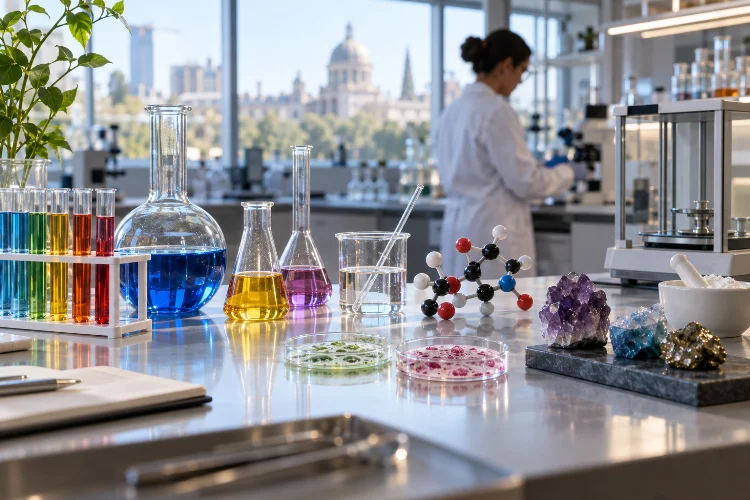
Chemistry is not limited to laboratories filled with glass containers and people wearing white coats. It is happening when soap removes grease, fruit turns brown, food cooks, sunscreen absorbs ultraviolet radiation, or a refrigerator transfers heat.
Batteries provide a clear example. They store chemical potential energy and convert it into electrical energy, allowing phones, laptops, cars, medical devices, and many other technologies to operate.
Medicine also depends heavily on chemistry. Researchers study molecular structures to discover drugs, understand how compounds interact with the body, and develop safer ways to deliver treatments.
Agriculture uses chemistry to examine soil nutrients, fertilizers, crop protection, water quality, and plant growth. Food scientists rely on it to improve safety, nutrition, taste, texture, and shelf life.
Chemistry is equally important in addressing global challenges. Cleaner fuels, recyclable materials, water purification, carbon capture, renewable-energy systems, and improved batteries all require a detailed understanding of substances and chemical reactions.
Basic chemical literacy can therefore help you evaluate product labels, environmental claims, health information, and new technologies more critically.
Chemistry is the science of matter, its properties, and the changes it experiences. By studying atoms, elements, molecules, chemical bonds, reactions, and energy, chemistry explains both ordinary experiences and advanced technologies.
It tells us why food cooks, medicines work, metals corrode, batteries produce electricity, and different materials behave in different ways. It also gives scientists the tools needed to address challenges involving health, energy, agriculture, manufacturing, and the environment.
The best way to begin learning chemistry is to stay curious. Look at an everyday event-such as ice melting, bread browning, or soap removing oil-and ask what is happening at the particle level.
Start with the fundamental concepts, explore one topic at a time, and let the world around you become your first chemistry laboratory.