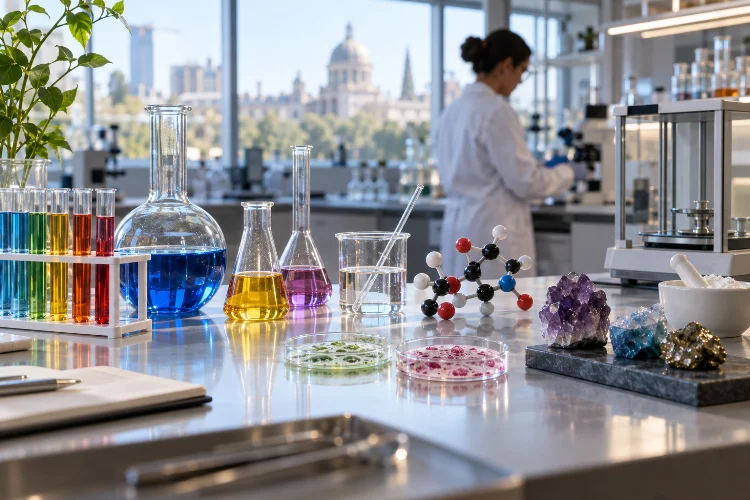

Chemistry might remind you of complicated equations, laboratory coats, and a periodic table covered with unfamiliar symbols. In reality, chemistry is already part of almost everything you do from the moment you wake up.
The toothpaste you use, the food you cook, the medicine you take, and the battery inside your phone all depend on chemical principles. Even breathing involves a continuous series of reactions that allows your cells to release energy from nutrients.
Understanding why chemistry is important in everyday life is not only useful for scientists. Basic chemical knowledge can help anyone cook better, use household products safely, understand health information, and make smarter choices about food, energy, and the environment.
Chemistry is essentially the study of matter, its properties, and how substances change. Since everything around us is made of matter, chemistry offers a practical way to understand the world at the level of atoms and molecules.
The American Chemical Society notes that seeing, tasting, touching, and many other ordinary experiences involve chemical reactions and interactions.
1. Chemistry Helps Us Understand the Human Body
The human body is like an incredibly complex chemical factory. Thousands of reactions take place inside it every second, even when you are sitting still or sleeping.
Digestion is a good example. Enzymes break large food molecules into smaller substances that the body can absorb. Carbohydrates may be converted into simple sugars, proteins into amino acids, and fats into fatty acids and glycerol.
Chemistry also explains how the body maintains a stable internal environment. Blood acidity, oxygen levels, body temperature, hormones, and mineral concentrations must remain within suitable ranges for cells to function properly.
When you exercise, your muscles require more energy and oxygen. Chemical reactions inside the cells release stored energy from nutrients, while the body adjusts breathing and blood circulation to meet the increased demand.
Learning basic biochemistry can therefore make nutrition, fitness, and health advice easier to understand. Instead of thinking of food only as calories, you begin to see it as a mixture of molecules that the body uses for energy, growth, repair, and communication.
2. Chemistry Makes Modern Medicine Possible
Medicines work because their molecules interact with specific structures in the body. A drug may block an enzyme, activate a receptor, reduce inflammation, kill microorganisms, or change the way cells communicate.
The shape and chemical properties of a medicine influence where it travels and how it behaves. Researchers study factors such as molecular structure, solubility, stability, and toxicity when developing new treatments.
Some medicines act by fitting into cellular receptors in a way that is often compared to a key entering a lock. Depending on the medicine, this interaction can activate or block a biological response.
Chemistry is also essential for choosing the correct dose. Too little of an active ingredient may not produce the intended effect, while too much could increase the risk of harmful side effects.
Pharmacists and pharmaceutical scientists also use chemical knowledge to create tablets, liquids, injections, creams, and controlled-release products. The goal is not simply to discover an active molecule, but to deliver it safely and effectively to the right part of the body.
3. Chemistry Is Happening Every Time We Cook
A kitchen is essentially a small chemistry laboratory. Heating, cooling, mixing, fermenting, and baking all change the structure or behavior of ingredients.
When an egg is cooked, heat causes its proteins to unfold and form new connections. The clear, runny egg white becomes solid and opaque because its molecular structure has changed.
Bread and meat develop brown surfaces through a group of chemical reactions involving amino acids and sugars. These reactions create many of the flavors and aromas associated with roasted, toasted, and grilled foods.
Acids and bases also influence cooking. Lemon juice can slow the browning of cut fruit, while baking soda can help dough rise or affect the texture and color of certain foods.
Food safety relies on chemistry as well. Scientists examine nutrients, allergens, additives, contaminants, and compounds formed during food processing.
The FDA uses chemical research and exposure information when evaluating whether substances in food are safe at particular levels.
Understanding a little food chemistry can help you troubleshoot recipes, store ingredients correctly, and recognize that the word “chemical” does not automatically mean dangerous. Water, vitamins, proteins, and natural flavors are all chemicals too.
4. Chemistry Makes Cleaning More Effective-and Safer
Cleaning products work through chemical interactions. Soap and detergent molecules have one part that is attracted to water and another part that interacts with oils and grease.
This structure allows them to surround oily dirt so it can be lifted from a surface and washed away. Warm water may improve the process by helping fats soften and increasing the movement of particles.
Different products are designed for different tasks. Acids can help remove mineral deposits, while alkaline cleaners may be effective against grease. Disinfectants are formulated to destroy or deactivate certain microorganisms.
However, knowing basic chemistry is also important for household safety. Cleaning products should not be mixed casually simply because each one works well on its own.
The CDC warns people never to mix household bleach with other cleaners or disinfectants because the combination can release dangerous vapors. Product labels, ventilation guidance, and recommended dilution instructions should always be followed.
Chemistry therefore helps us understand not only why cleaning products work, but also why using the correct product in the correct way matters.
5. Chemistry Powers Phones, Cars, and Other Technology
Modern technology depends heavily on the chemistry of materials and energy storage. Smartphones, computers, screens, solar panels, cables, and electronic components all require carefully designed substances.
A phone battery, for example, stores chemical potential energy. During use, chemical processes inside the battery move charged particles and generate an electrical current that powers the device.
Rechargeable batteries are designed so that many of these processes can be reversed when electricity is supplied. However, the reversal is not perfect, and changes in battery materials over time can gradually reduce performance.
Chemists help develop battery materials that store more energy, charge faster, last longer, and reduce safety risks. These improvements affect portable electronics, electric vehicles, medical equipment, and renewable energy systems.
Materials chemistry also allows manufacturers to create lightweight plastics, durable coatings, heat-resistant glass, flexible displays, and corrosion-resistant metals. The properties of a product are closely connected to the arrangement and bonding of its atoms.
6. Chemistry Protects Water and the Environment
Clean water may look simple, but its quality depends on many chemical, physical, and biological factors. Clear water can still contain dissolved minerals, metals, nutrients, microorganisms, or pollutants that cannot be seen.
Water-quality testing often measures characteristics such as pH, dissolved oxygen, salinity, and the concentration of specific contaminants.
The U.S. Geological Survey defines water quality according to how suitable water is for a particular use based on selected physical, chemical, and biological characteristics.
Chemistry helps treatment facilities remove unwanted substances and make water safer. Processes may include filtration, adsorption, disinfection, oxidation, and adjustments to acidity.
Environmental chemists also study how pollutants move through air, water, and soil. They examine how long substances remain in the environment, whether they accumulate in living organisms, and how they might break down.
The same scientific knowledge supports the development of biodegradable materials, cleaner manufacturing methods, better recycling systems, and technologies that use fewer hazardous substances.
Green chemistry aims to design products and processes that reduce waste and environmental harm from the beginning, rather than dealing with pollution afterward.
7. Chemistry Helps Us Make Better Daily Decisions
Basic chemical literacy makes it easier to evaluate the claims we encounter every day. Advertisements often use words such as “natural,” “chemical-free,” “toxin-free,” or “scientifically proven,” but these phrases can be misleading without context.
Everything made of matter contains chemicals, including plants, drinking water, and the human body. Whether a substance is harmful depends on factors such as its identity, amount, method of exposure, and how long the exposure lasts.
Chemistry can also help you read product labels more critically. You may better understand why medicines have dosage instructions, why foods require certain storage conditions, or why cleaners should be kept away from heat and other products.
This does not mean everyone needs to memorize the periodic table. It means learning enough about concentration, reactions, acidity, energy, and molecular structure to ask better questions.
Scientific understanding can reduce unnecessary fear while encouraging appropriate caution. It helps people separate reliable evidence from exaggerated marketing and viral misinformation.
Chemistry is important in everyday life because it explains how our bodies function, how food changes during cooking, how medicines work, and why cleaning products remove dirt.
It also supports the batteries, materials, water-treatment systems, and environmental technologies modern society depends on.
You do not need to become a professional chemist to benefit from this science. Even a basic understanding of chemical reactions, substances, energy, and concentration can help you make safer and more informed choices.
Start paying attention to chemistry in your daily routine. The next time you cook an egg, charge your phone, wash a greasy plate, or read a medicine label, pause and consider what is happening at the molecular level.
Everyday life becomes far more interesting when you understand the science behind it.